Monday, April 11, 2011

Notes from Seth Klarman's Youtube Videos

I came across some videos of successful money manager Seth Klarman of the Baupost Group. Klarman is the author of the $900 book, Margin of Safety: Risk-Averse Value Investing Strategies for the Thoughtful Investor. When I was watching I was blown away with the rapid-fire investment truisms. So I decided to jot them down:
  • value investing is a risk averse approach - focus on risk before return
  • Ben Graham's net working capital test - if you can buy a stock for less than 2/3 its networking capital (working capital - all liabilities) then that's a bargain. You are buying a company for less than you could liquidate the business for.
  • three underlying pillars:
    • Focus on risk before return. Focus on multiple scenarios, i.e. what can go wrong, what's the worst thing that can happen. Create a range of possible outcomes, don't rely on single point estimates. Volatility isn't risk, volatility creates opportunities.
    • The world is oriented toward relative performance. People who are risk averse should be focused on absolute returns. If you are focused on absolute returns, the idea of losing other people's money is abhorent. If you're focused on relative performance then you're OK with that.
    • The importance of being bottom-up and not top-down. Interest rate and the stock market direction forecasting are incredibly difficult to perform well.
  • Baupost. When they set it up they wanted to have flexibility - a wide mandate - in order to have as large an opportunity set as possible. The more weapons available in your mandate  the better chances you will have to take chances of mispricings. They also set it up to have capital alongside their clients. They don't allow people to have significant holdings outside the firm. The firm is highly collaborative; people are able to make an impact even at a junior level. Capital isn't siloed or allocated to specific people; it is able to move to different opportunities as they arise. Baupost's edge is in complicated situations.
  • To invest in something you need an edge. They need to have a reason that they will outperform. The biggest edge someone can have is a long-term orientation. It's easy to say you do, but harder to implement it. Also, you need a catalyst: what is going to cause a mispricing to correct itself. Or a supply/demand imbalance like distressed debt where, as a bond is down-graded, there is forced selling.
  • Spin-offs and index inclusion/exclusion are both good sources for deals.
  • Relationships are important. They work hard to have the best clients and the best brokers. Trust. The team has worked together for a long time.
  • Pharmaceutical company that invented a number of drugs - PDL Biopharma 30% IRR on the likely collections from drug patents.
  • Risk vs. Return:
    • Intensive sensitivity analyses on everything they do. A whole variety of assumptions. E.g. what if defaults are 5%, 10%. If a security, even with Depression-like scenarios, passes these tests then it is a good buy.
  • Easy to find things that aren't efficiently priced.
  • Baupost never uses modern finance, i.e. WACC or ROIC. Instead, use a range of values.
  • Often the greatest opportunities are around the peripheries of things. If people are looking at
    the S&P 500, you should look at the 501st company. Where do we earn enough to buy and hold this entire company?
  • Which value managers do you admire?
    Buffett and Munger for one.
    FPA Crescent team. Southeastern Asset Management. Tweedy Brown.
    Paul Singer. David Abrams. Perry Capital. Jeff Hallis. Michael Lowenstein. Steve Mandel.
  • Looking for egregious mispricings. Looking for low-risk, high-return situations.
  • Never believe that something will go well beyond fair value. We don't hold on for the last nickel. Don't fall in love with a stock because it acts well.
  • One of the biggest mistakes that investors make is overdiversification. This presupposes that losses will be one-off events rather than the entire market moving against you. This limits your return and doesn't really limit your risk that much.
  • You need to be able to tell a great idea from a good idea.

Thursday, April 7, 2011

What I Learned from Phillip Fisher's Common Stocks

I would not recommend the book Common Stocks and Uncommon Profits and Other Writings (Wiley Investment Classics) for anyone. However, my displeasure with it didn't deter me from finishing it once I picked it up. I don't quit on things. My philosophy is: power through. These are my general feelings on the book, written as part of a review on the Amazon reading list app of LinkedIn:
"My expectations for this book were high. I was severely disappointed. The best part of this book is that it's over. The worst part of this book is that Phillip's son Kenneth owns the rights to the book. He took that privilege, ran with it, and abused the hell out of it. Kenneth, a billionaire investor, droned on for a dozen pages of prologue before writing another 27 for the introduction. If you happen to pick up this copy, and I suggest that you don't, skip all of Kenneth's writing. It's horriblely egotistical, monotonous, and empty of any informational value whatsoever.
Phillip writes like I hope that I don't: overly verbose with too complicated a sentence structure. His writing also has too many references to previous statements so quoting him is very difficult. In my view, the best investment writers drop little nuggets of wisdom that are highly quotable. Because of the way Fisher writes, you won't get much of that from this book. The other problem with the writing is that there are too many examples so the book doesn't stand up historically. I don't want to read about Dow Chemical in the '50s or Motorola in the '70s. Both of these stocks are also written about because Fisher owned them which I also found annoying.
I did find bits and pieces that I believe was adopted by other investment managers, e.g. three year rule, buying something when it is priced well and not haggling over 1/8ths.
However, I recommend that you skip this book."
Not enjoying the book also didn't prevent me from learning. I keep a journal of ideas that I want to keep when I read. I want to share with you those ideas that I came away with from this book. [I cleaned up his gratuitously elongated speech for my own records.]
  • In the case of really outstanding companies, the information is so crystal clear that even a moderately experienced in vestor who knows what he is seeking will be able to tell which companies are likely to be of enough interest to him to warrant taking the next step.
  • You need to have patience if you want to make big profits from an investment. Put another way, it is often easier to tell what will happen to the price of a stock than how much time will elapse before it happens.
  • Doing what everybody else is doing at the moment, and therefore what you have an almost irresistable urge to do yourself, is often the wrong thing to do at all.
  • Just as even the best professional baseball players cannot expect to get a hit more than one out of every three times he comes to bat, so a sizable number of stocks are bound to produce nothing profitable at all.
  • If you want to gauge a management's orientation towards profits (short- vs. long-term) then look to the treatment of customers and vendors. It provides a very good indicator.
  • Stocks should not be bought where the dividend payout is so emphasized that it restricts realizable growth.
  • Practical investors usually learn their problem is finding enough outstanding investments, rather than choosing among too many.
  • Usually a very long list of securities is not a sign of a brilliant investor, but of one who is unsure of himself.
  • To make big money on investments it is unnecessary to get some answer to every investment that might be considered. What is necessary is to get the right answer a large proportion of the very small number of times actual purchases are made.
  • His three principle, two I's and an H: integrity, ingenuity, and hard work.
  • A good place to start with a conservative investment is with an industry's lowest cost producer, because:
    • the higher margin allows the company to weather poor business conditions better
    • the margin also allows the company to earn enough that they won't need to seek additional financing
  • The largest profits in the investment field go to those who are capable of correctly zigging when the financial community is zagging.
  • Contrary opinion is not enough, however. When you do go contrary to the general trend of investment thinking, you must be very, very sure that you are right.
  • Three year rule: each investment should be given three years in order to draw a conclusion from the investment thesis.
  • "If you can't do a thing better than others are doing it, don't do it at all."

Thursday, March 31, 2011

First Quarter 2011 Reading List

I wanted to take some time to share with you my thoughts on the books that I've read in the first three months of the year. In December, I decided to share all of the books that I read in 2010. As a person who reads roughly a book a week, the post was too bulky to be very good. [I was bogged down with studying for the CAIA designation so I slowed down in late February/early March.] So I decided to break it up into quarters. In the future I might do it in a monthly post.

Thursday, March 31
by David Einhorn
Recommended
Comment: "This book was wonderful. It was exactly the way the book "Confidence Men", the story of the struggle William Ackman had in his pursuit of raising concerns of MBIA, should have been written. Mr. Einhorn grabs the reader's attention from the first chapter. If he weren't already a successful hedge fund manager he would definitely be able to find employment as an author. It was that good. Joel Greenblatt claimed that he read the book in two sittings. That wasn't possible for me, but it did only take me three days. I couldn't put it down.
In all of the books I read I mark passages that are outrageous with !. This book's margins are covered in them. The story of Einhorn's struggle with management is characterized by outlandish claims, horrific valuations, childish rants, and CIA-type operations.
The takeaway question I came away with was: is the cost of being publicly short (and subsequently being right) worth it? With all the strains and scrutiny Mr. Einhorn and Mr. Ackman went through, I'm not sure I can say that it is.
"

Monday, March 28
by Diane Dreher
Comment: "This book was very interesting for the first 150 pages. That section of the book encompassed most of the self-improvement instruction which was wonderful. I enjoyed how she blended Tao Te Ching passages with both explanations and everyday examples. However, the rest of the book wandered through a miasma of self-congratulatory hippy BS like recycling and bringing your own reusable bags to the grocery store. Not helpful at all. If anything, this book will make me explore the Tao Te Ching further because I found it to be both fascinating and enlightening."

Wednesday, Mar 23
by John Feinstein
Comment: "It is tournament time! I thought I'd get my head in the game by reading a story about Bobby Knight.

This book was a fair portrayal of a complex man. Feinstein describes Knight as a highly loyal, nice, caring, intelligent albeit tempermental and controlling. The book is really an insider's look at the Bobby Knight 1985-86 team, the year after the chair throw at Purdue and the year before his third championship season. It was a season of ups and downs. I think Feinstein did a good job of describing what it was like as a player in Knight's locker rooms even if his narrative of the games was a little too elaborate.
"

Tuesday, Mar 15
by Jeffrey Pfeffer
Recommended
Comment: "Great book on power and influence. Stanford Professors Jeffrey Pfeffer lays down the argument to gain more power and then proceeds to detail how you can go about getting it. This book was not just a well written blueprint. Rather, it was pretty thought provoking as well.
For instance, at one point he discusses democratic institutions and how they are the exception, not the rule in all of our society's organizations, be they companies or non-profits or government agencies. It made me question why, growing up and in school, adults always stress voting and consensus-building as the method to make decisions. I think that is just another way we under prepare children for success in adulthood.
"

Monday, Feb 28
by Warren E. Buffett, Lawrence A. Cunningham
Recommended
Comment: "The best source for information on Buffett's investment style and thought process is Buffett himself. Lawrence Cunningham effectively organizes Buffett's essays from 30 years of annual reports (not the partnership letters mind you) into very clearly defined narratives that follow a syllabus-like approach. After finishing it, I can't believe what took me so long to find this book. The value that this book provides is well worth the cost and the time to read it. I recommend it to anyone who is at all interested in Buffett."

Tuesday, Feb 15
by Joe Nocera, Bethany McLean
Recommended
Comment: "Great book on the financial crisis. Nocera and McLean start their book much earlier than the other books in the genre. They explain all of the legislative and regulatory changes as well as the development of the mortgage backed securities and subsequent securitizations that occured in the 1980's and 1990's as laying the groundwork for the 2003-2007 housing bubble. The only shortcoming of this book is that the authors stand on the backs of other books such as Fool's Gold and Too Big Too Fail to quickly go through the narrative of the actual crisis. The meat of this book, and its comparative advantage, is in developing the backstory. I learned a ton about Fannie and Freddie and MBS's by reading this book and I recommend it to anyone with an interest in these topics."

Monday, Feb 7
by Pat Conroy
Recommended
Comment: "This book is a gripping novel about the "Carolina Military Institute", a not-so-clever euphemism for the Citadel. Having no military background I thought this book might fall flat for me, but that wasn't the case. Pat Conroy weaves many different narratives together superbly, including a discussion on the Vietnam era, the vanity and "what's behind the curtain" in Southern aristocratic society, as well as the solitary man against the established order main narrative.
I've now read three Pat Conroy books in the last four months and I've loved all of them. I encourage you to seek them out. I think I'll eventually pick up "My Losing Season" which is supposed to be more autobiographical about his experience in college because of my positive read of this book.
"

Monday, Jan 31
by Roger Lowenstein
Recommended
Comment: "This is the book that all other Buffett books should be judged by. If you want to know about Buffett, not just the man as you'll get in "The Snowball, but also his investing then this is the best book to read."

Tuesday, Jan 25
by William Breit, Barry T. Hirsch
Comment: "This was a Christmas present. Lives of the Laureates is a compilation of 18 lectures given at Trinity University by Nobel laureates in economics. Many of the lectures are thick with names and titles and read more like a bibliography than an autobiography. But then you get to the really interesting economists like William Sharpe or Paul Samuelson who are able to see past the litany of their papers and connect the dots of their careers.
There are many themes in this book, like the fact that they all seemed to become indoctrinated into the mathematics of economics through PAS's "Foundations of Economic Analysis" and the Chicago school thread seemed to run through all of them.

Monday, Jan 24
by Thornton L. O'glove
Recommended
Comment: "This book was a fantastic exposition on what to watch out for when it comes to a company's earnings. It talked about everything: inventory schemes, nonoperating/nonrecurring income, and increasing/decreasing expenses. I thought it was not just fascinating, but very informative. I can really apply these principles in my own due diligence.
Also, if I get into a doctoral program this fall, I will definitely re-read this book for doctoral ideas because I had at least a dozen in my first pass-through.
"

Thursday, Jan 13
by C. H. Dalton
Recommended
Comment: "Despite the shocking title, this book is laugh out loud hilarious satire. Almost every page has a joke that made me chuckle. I never knew a book could be so funny."

Monday, Jan 10
by Lee Eisenberg
Comment: "As the title suggests, this book is about thinking about the rest of your life. But do not be led astray, while it does talk at length about "the Number" the computation of the number is cast aside as an afterthought. The author seems to have an ax to grind with the personal finance industry which he believes spends to much time focusing on the quantitative value of the number while underemphasizing the more important aspect of the number, which is what that money can buy, i.e. happiness. If there is anything that I dislike about the book, which was interesting and engaging if not infuriatingly repetitive, it is the deceptive nature which it breaches into a genre which it clearly is not. If it were actual personal finance then the computation of the number would not be discussed only included as an appendix. Rather it favors a broad discussion of what that money should buy - the pursuit of a passion is the author's preference - so that it functions more as a self-help book to enjoying retirement rather than actually planning for it."

Thursday, Jan 6
by Ryan North, Matthew Bennardo, David Malki !
Recommended
Comment: "Holiday fun reading!
This book is a collection of short stories revolving around an idea that was spawned by a comic that Ryan North, of Dinosaur Comics fame, printed in 2005. In the comic, T. Rex talks about a machine of death which prints ambiguous readings and is never wrong.
This book was a whole lot of fun, but on a deeper level this book touched on two extremely complex issues, free will and the struggle between order and chaos. I would recommend it to anyone because it was highly entertaining.
"

Thursday, February 24, 2011

More on Inequality

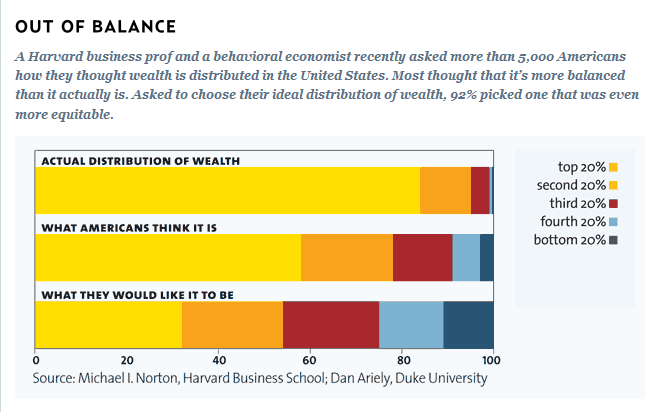
I thought this graphic was fascinating:

I think this is a great graphic that reflects more on the majority of Americans' numeracy than it does on their actual views on wealth distribution. But if we assume that everyone has a good grasp on percentages then we could conclude that the majority of Americans are advocates for more redistributive policies (not my preference).

I have long held the belief that if you hit the restart button on society and reallocated all of its resources equally to everyone, within a short amount of time, the distribution would shift towards the middle bargraph. I believe that certain people are ingrained to spend, even beyond their means, which certain other people finance because they are ingrained to save. So eventually we reach an equilibrium where the top 20% (extreme savers) accumulate a much larger percentage (multiples) of society's assets than the bottom 20%. Add on the compounding of interest over years - positive for the savers and negative for the borrowers - and you can quickly see how the gargantuan gulf in wealth is formed.

Hat tip: The Reformed Broker.

Thursday, February 17, 2011

Haiku - Momentum

Momentum trading
Will price trends really persist?
Yes, concludes research.

I debated the last line as either what appears or "Hedge funds bet on it." I think what appears is probably stronger.

Thursday, February 10, 2011

Great Quote - Corporate America

I'm reading Bethany McLean and Joe Nocera's book "All the Devils Are Here: The Hidden History of the Financial Crisis", which is fantastic. They really stick it to the subprime originators, Fannie and Freddie, and the ratings agencies. One of the passages I was reading yesterday caught my eye:
"The people who are propelled upward...in corporate America are the guys who said yes to an idea that worked", he [former Countrywide President Stan Kurland] later told a friend. "The guys who said no to a big failure--there's no list for that. That's why we end up with bubbles." (pg. 142)
Isn't it so true? The people who get promoted are the people who ran with an idea in the face of doubters. The world is littered with skeptics - the people who say "that can't be done" - and the quickest way to get on the boss's radar and curry favor is to be positive, wage conflicts against coworkers, and win. Except in this instance, the "victory" for the man who went against the skeptical Kurland (most likely David Sambol) which pushed Countrywide into higher-risk subprime loans only amounted to short-term gains. Kurland's no's eventually led him to leave the company in late 2006. The yes-man was "right" for less than a year as the subprime market began to sour in the fall of 2007. From Wikipedia:
In the third quarter of 2007, subprime ARMs making up only 6.8% of USA mortgages outstanding also accounted for 43% of the foreclosures which began during that quarter.[21] By October 2007, approximately 16% of subprime adjustable rate mortgages (ARM) were either 90-days delinquent or the lender had begun foreclosure proceedings, roughly triple the rate of 2005.[22] By January 2008, the delinquency rate had risen to 21%[23] and by May 2008 it was 25%.[24]

Wednesday, February 9, 2011

A Portrait of Inequality

Economists spend a lot of time thinking about inequality, because of all the effects it has on society: life expectancy, disease rates, crime, happiness, social cohesion, and economic incentives. As a group, economists often fail to make numbers come alive (if you want to see someone who can make graphs more interesting than anyone try googling Hans Rosling). But I found this exerpt from The Economist to be especially interesting and informative:
Jan Pen, a Dutch economist who died last year, came up with a striking way to picture inequality. Imagine people’s height being proportional to their income, so that someone with an average income is of average height. Now imagine that the entire adult population of America is walking past you in a single hour, in ascending order of income.
Via kottke.org.

Tuesday, February 8, 2011

Crowds Make Me Feel Lonely

On Sunday, my girlfriend and I went to a Super Bowl party. The party was a good time, but the conversations that I have with regular people outside of work make me realize how far my views are from mainstream. For one thing, I'm a die-hard libertarian. I find people's individual rights to be a great frame of reference when I think about politics. I don't know how other people form their own opinions but I'm not optimistic they have such a consistent groundwork as individual liberty. Here are a few examples of conversations that led me to the conclusion which is the title of the post:
  1. For example, one guy was talking about Redskins owner Dan Snyder who purchased a property on the Potomac a few years ago. He wanted to remove some trees that were obstructing the view from his house of the river. Some environmentalists didn't like this because the trees are "old". The speaker went on to express his populist "soak-the-rich" ideas about Snyder and how he deserves to get sued. It wouldn't have been congenial for me to have started a debate about it at the time, but it was informative that my pro-property rights and to some extent elitist views are not shared by my peers. There is probably some level of separation that happens which leads to the difference - I would put myself in Dan Snyder's place by saying "if I paid tens of millions of dollars for a home I damn well better be able to do whatever I want with it" and they probably don't project into that situation because they (perhaps rationally) don't believe it will ever apply to them.
  2. Another example but the same guy was talking to two ladies about the "rapist" Ben Roethlisberger. I didn't engage with him but I couldn't let it go without getting the thought off my chest. I turned to my girlfriend and said "you know in this country you are presumed innocent until proven guilty but if the verdict is innocent you're still guilty in the public's eyes just by virtue of being accused".
  3. The final example that I have is from the commercial where they are doing "baby tests" and the baby flies forward and smacks into glass then slides down. The girls' mouths were agape. One girl said "that's awful" and another said "that's tasteless". While I agreed the commercial wasn't a.) funny or b.) effective and so c.) good - it wasn't for the same reason. Obviously they didn't use real babies, but these twenty-something girls' maternal instincts were so strong that they couldn't shrug off a simple (albeit not funny) joke. I have no such proclivities about babies. I think that maybe those women are the types of people that outsource their higher level thinking and will eventually develop into the types that boycott movies that aren't endorsed by the ASPCA/Catholic Church/MADD/whatever other institution they allow to dominate their thoughts and opinions.
The internet has probably allowed our society to have more divergent opinions then ever before. I say this because everyday I read articles and blogs by people that agree with me, which indulges my confirmation bias. Finding people who agree with you isn't hard anymore. The effect is that I feel surrounded by like-minded people despite the fact that those who are actually surrounding me may not share those opinions. Before the internet if you wanted to be up-to-date on events you had only one or two providers of newspapers in a city, only three nightly news shows and if you wanted to debate then you had to settle on whoever was at the local bar. Now you can get the news from the people that filter it through your preferred shade of glass and you can debate with people that already think like you. I wonder if this is the type of mechanism that is leading to outcomes like this article from this weekend calling Obama the most polarizing president ever.
-JDW

Friday, February 4, 2011

Reason # 1977832 that I love Netflix

I've been a subscriber to Netflix since June 2007. This week I received my 500th disc through the mail. (FYI - it was "The Expendables" but I wish it were something more high brow to impress you.) I am a huge fan of Netflix and I have probably been responsible for at least a dozen people signing up, including my parents who joined last year.
I thought I knew all about Netflix, but by accident I learned something new last month. I always thought that if you place something that was on a short or a long wait at the top of your queue then you wouldn't receive any more movies until you were reached the top of a secondary queue for that specific movie. It probably would be that way if Netflix were run by Blockbuster. But thankfully for us the hard-working consumer they aren't. Instead of not receiving a movie at all, they skip to the next available movie on your queue and then, when the movie that had a wait time becomes available they send it to you whether or not you already have your maximum amount of movies checked out.  How awesome is that!?
So many businesses fall into the "we're the supplier so we call the shots" mentality that you are amazed when you come across a business that totally understands the consumer perspective.
The other consumer-friendly practice Netflix has is they send out emails to the tune of "hey, was the picture on that movie you watched last night kind of crappy? We think it was because our engineers noticed high demand so our quality suffered. If it was, click here and we'll refund part of your bill." Awesome.
They totally have me. I get so much consumer surplus, that is the amount of extra joy I get from not paying what I would, that if they doubled the price I wouldn't think about canceling my subscription.

Wednesday, February 2, 2011

Haiku - Calendar Spread

A calendar spread
Go long next month, short distant
Neutral market play.
-JDW